

Applications & Industries · September 11, 2026
Zinc Die Cast Industrial Connectors: Housings, Hoods and Coupling Nuts
Which parts of an industrial connector are made by zinc die casting, why zamak beats aluminium, brass and plastic on housings and coupling nuts, which ZP alloy to choose, and what to expect from tooling and finishes.
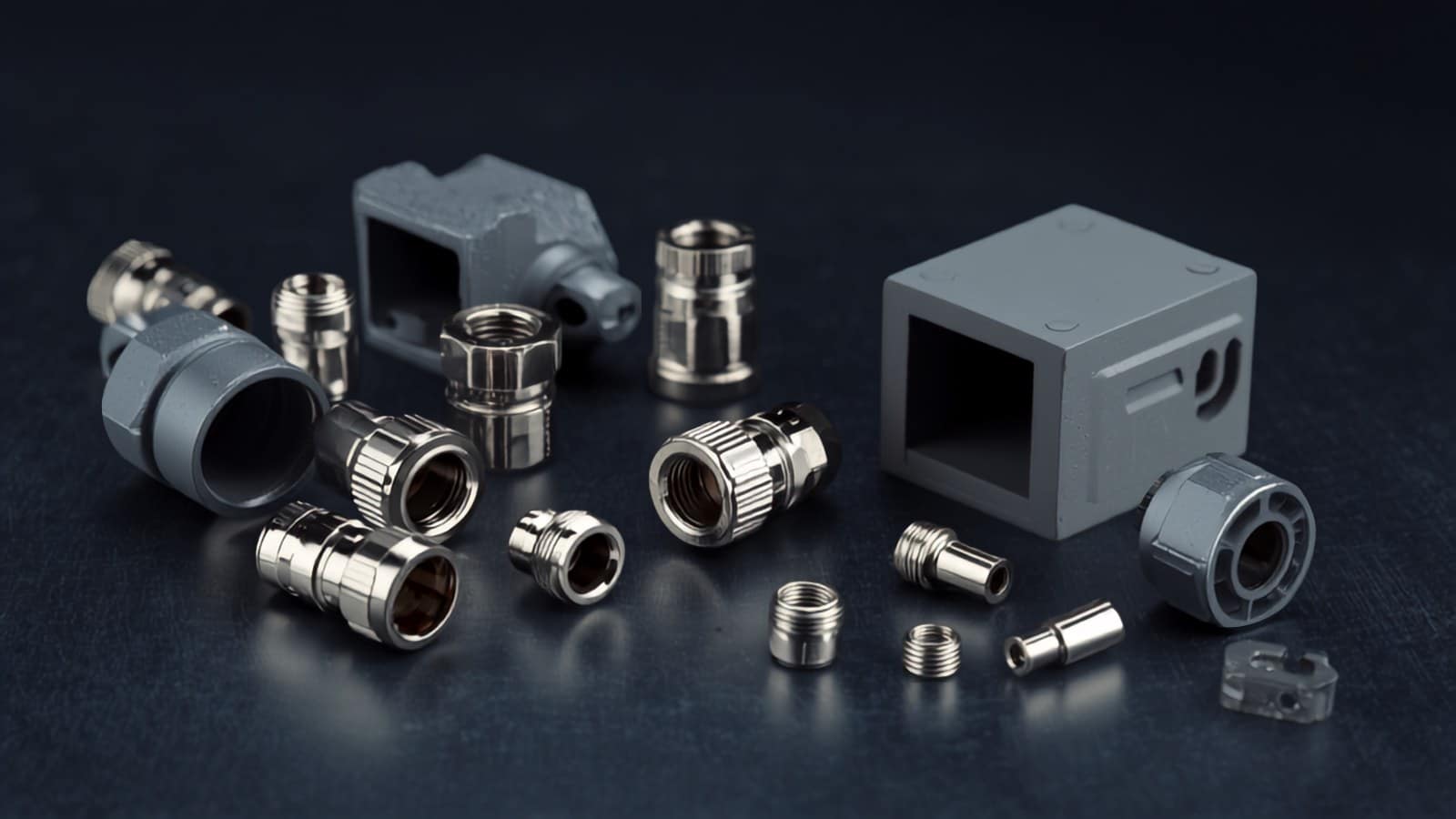
Zinc die cast industrial connectors are the housings, hoods, coupling nuts and backshells produced by injecting a zinc alloy to EN 12844 — usually ZP3 or ZP5 — into a steel die at around 420 °C in a hot chamber machine. Compared with an aluminium housing, zamak allows thinner walls and threads cast directly in the part; compared with plastic, it provides intrinsic electromagnetic shielding and withstands mating cycles; compared with turned brass, it costs less for the same nickel finish once batches are large. It is the usual choice for M12 and M23 coupling nuts and housings, D-Sub hoods, compact housings of rectangular heavy-duty connectors and non-sparking versions for explosive atmospheres.
What we are talking about (and what we are not)
This article is about the metal parts of electromechanical industrial connectors — M8, M12, M16 and M23 circular connectors, rectangular heavy-duty connectors for panels and machinery, shielded D-Sub connectors, distribution boxes and splitters, cable gland elbows and flanges — that come out of a die casting tool and a zinc alloy. It is not about overmoulded plastic cable plugs, nor about jewellery findings, both of which sometimes go by the same name in catalogues.
The parts that are die cast in zamak have precise names, and it pays to use them on the drawing and in the request for quotation:
- Body or housing: the part that holds the contact insert and defines the mating interface.
- Hood: the cover that protects the cable termination on rectangular connectors.
- Backshell: the part that captures the cable shield and connects it to the body.
- Coupling nut: the threaded or knurled ring that locks the mating on circular connectors.
- Locking levers, brackets and flanges: locking and panel-mounting elements.
- Cap nuts, elbows and reducers of cable glands: non-turnable geometries that die casting produces in a single shot.
One boundary should be drawn right away: CEE plugs and sockets to IEC 60309 are almost always polyamide or engineering plastic, and the high-current metal versions are aluminium alloy. There, zamak only appears in accessories — hooks, interlock levers, brackets — not in the enclosure. For the overall picture of the process, see our zamak die casting guide.
Why the connector body is made of zamak
A connector body is made of zamak when the same part needs electromagnetic shielding, thin walls, cast-in threads and a surface ready for nickel plating, in production batches. These are five properties that the alternatives offer one at a time.
EMI shielding and ground continuity
Zinc die casting alloys have an electrical conductivity of around 26–27 % IACS (NADCA data for ZP3 and ZP5): a one-piece die cast housing is a Faraday cage with no additional conductive coating. In a connector the real shielding depends more on the joints than on the material, which is exactly why a single casting — body, seal seat and backshell interface in the same part — performs better than an assembly. The topic is covered on our page about zinc die cast components for electronics and EMI shielding.
Thin walls and fine detail
Hot chamber die casting of zamak fills geometries that aluminium does not: the design guidelines of the International Zinc Association give 0.8–1.5 mm as the typical wall range, with short sections below half a millimetre using the most fluid alloys. For an EMI housing this means less weight and more internal room for the same external envelope, which in M12 and M8 formats is the dimension that decides everything.
Threads and seal seats in the casting
An external thread can be die cast if the parting line splits it in half; an internal thread needs an unscrewing core or a machining operation. The same applies to O-ring grooves and to holes for thread-forming screws: if they are designed into the die, the part comes out finished and never goes to the lathe. That is why the rule stated in manufacturers’ catalogues reads «zinc die casting for large lot sizes, turned brass for round parts in small lots».
Repeatability and tolerances
The hot chamber runs short cycles at low casting temperatures, and this keeps dimensions stable from batch to batch: the economical tolerances quoted by industry guidelines are in the order of 0.1 mm on dimensions up to 25 mm, and on the critical dimensions of a thread or an O-ring seat you get down to ±0.05 mm straight from the die. Our 11 machines from 20 to 90 tonnes, seven presses and four robotic cells, cover the typical formats of these components, from a few grams to a few hundred.
Die life
Zamak is cast at around 420 °C, aluminium at around 660 °C: the difference is paid by the die steel. A European patent from 2008 on zinc die cast connector housings, filed by a German connector manufacturer, estimates the die life for the same housing at 500,000 to 3,000,000 shots in zamak against roughly 100,000 in aluminium, and lists as a further advantage the possibility of integrating fasteners and gland seats into the casting. A part that runs for years amortises the die over its whole production life.
Zamak, aluminium, brass or plastic: a comparison for the connector body
Each material has a zone where it pays off. The table compares the four candidates on the criteria that matter in a connector, not in general: for the overall comparison between alloys see the page on zinc alloys for die casting and the guide to the mechanical properties of zamak alloys.
| Criterion | Zinc die casting (ZP3/ZP5) | Aluminium die casting | Turned brass | Engineering plastic (PA, PBT) |
|---|---|---|---|---|
| EMI shielding of the body | Intrinsic, 26–27 % IACS, no conductive coating | Intrinsic, but the surface oxide penalises the joints | Intrinsic | None: metallisation required |
| Minimum cast wall | 0.8–1.5 mm typical, short sections below 0.5 mm | Usually 1.5 mm and up | Not applicable (from bar) | 0.8–1.5 mm |
| Threads | Cast (external) or machined | Almost always machined | Turned | Moulded, fast-wearing |
| Nickel and chrome plating | Excellent, with a copper underlayer | Difficult, pretreatment needed | Excellent | Metallisation only |
| Density | 6.6 g/cm³ | 2.7 g/cm³ | 8.5 g/cm³ | 1.1–1.5 g/cm³ |
| Operating temperature | Continuous up to about 100 °C, 125 °C peaks quoted by manufacturers | Above 200 °C | Above 200 °C | 100–140 °C |
| Die life | Very long (cast at around 420 °C) | Shorter (cast at around 660 °C) | No die | Long |
| Unit cost in series | Low: fast cycle, little machining | Medium | High: material and turning swarf | Very low at high volumes |
| When to choose it | Nickel-plated, shielded housings, coupling nuts and backshells with fine detail | Large enclosures, low weight, heat | Round parts in small lots | Insulating bodies, low-cost unshielded connectors |
And when zamak is not the right choice: in the large enclosures of rectangular connectors, where weight per kilogram favours aluminium; in turned parts in small lots, where brass avoids the die; above 100 °C continuous under load, where zinc alloys creep over time; in aggressive washdown for the food industry, where stainless steel wins. Saying it beforehand avoids a wrong part afterwards.
Which alloy to choose: ZP3, ZP5, ZP2 and ZP8 to EN 12844
The alloy is chosen for the individual component, not for the whole connector. ZP3 (tensile strength around 280 MPa) is the reference alloy for housings, hoods and covers to be nickel-plated: the most fluid, the most dimensionally stable, the easiest to plate. ZP5 (around 320 MPa) is the choice for coupling nuts, threads and loaded levers, where the alloyed copper raises hardness and creep resistance. ZP2 serves wear parts — locking levers, latching teeth — and ZP8 where the part works at temperature or requires very thin walls. The full comparison is in the article on how to choose the right zamak alloy: ZP3, ZP5, ZP2, ZP8.
A detail a connector manufacturer’s buyer always asks about: EN 12844 alloys limit lead and cadmium to 0.005 % and tin to 0.002 %, twenty times below the RoHS threshold for lead. The melt certificate states the alloy, and the RoHS and REACH declaration follows from it without additional analyses.
Designing the housing for die casting: six rules
A housing designed for aluminium or brass cannot be converted by copying it. Six rules we apply in co-design, from the STEP file to the first samples:
- Uniform wall, 0.8–1.5 mm, with generous radii: abrupt changes in section create porosity right where the shield runs.
- Draft angles of about 1° on internal surfaces and 0.5° on external ones; round holes can go down to 0.1°.
- External threads on the parting line, internal ones weighed between unscrewing core and machining: the decision is made on annual volume.
- O-ring seat with controlled stock allowance and finish: IP67 sealing is lost through a pore breaking out on the mating face, not through the material.
- Plating thickness in the dimensions of threads and grooves: 10–20 µm on an M12×1 change the fit.
- Cast-in shield continuity points — ribs, teeth, contact faces — so that the backshell makes ground without additional screws.
Before the die, a functional prototype settles envelope and assembly: we cover this in the 3D prototyping and DfM guide, and for the smallest formats in the article on micro die casting of small zinc components.
Finishes for connectors: nickel, chrome, powder coating
On zamak, nickel plating requires a copper underlayer: the copper → nickel sequence, with optional final chrome, provides adhesion and salt spray resistance. Matt or bright nickel is the finish of M12 and M23 circular connectors and shielded backshells: conductive, resistant to mating cycles, uniform on threads. Epoxy-polyester powder coating — grey or black — is the finish of compact rectangular connectors, where the surface does not have to conduct and impact resistance counts. Zinc-nickel appears in specifications that demand hundreds of hours of salt spray to ISO 9227.
Plating is carried out by qualified external plating shops, with which we coordinate thicknesses, tests and the coating declarations that recent specifications require. The other available finishes are in the zamak surface finishing guide.
Metal body and plastic insulator: overmoulded inserts
When the connector combines a shielding housing and an insulating contact carrier, the zamak body can become the insert onto which polyamide or POM is overmoulded. The casting must be designed for this — anchoring undercuts, tolerances in the overmoulding zone, a surface free of release agents — and it is best decided before the die: the details are on the page about zamak inserts for rubber and plastic overmoulding.
Die, costs, volumes and quality: what to expect
For a zamak connector body the die costs, as an indication and to be defined on the drawing, €12,000–15,000 if simple, €16,000–25,000 with mechanical movements, slides or multiple cavities, over €25,000 for complex geometries with unscrewing cores. The die is designed by our technical office and built under our direct supervision, remains the customer’s property and, if the shots are run on our presses, is guaranteed for 400,000 shots. Cost bands and scope of supply are described on the die design and construction page.
On the quality side, a connector manufacturer asks for three things, and asks for them in writing: a certified system — our ISO 9001 is certified by TÜV Italia —, initial sampling with a dimensional report on critical dimensions, which we supply on request in PPF or PPAP format, and the melt certificate with reference to the EN 12844 alloy. With 75,000 kg of zamak processed per month on two shifts, the typical cadence of an annual frame contract with call-offs falls within ordinary capacity. On how to set up the request we have written a guide on the hot chamber process and how to choose a supplier; for a concrete case, the drawing and the annual volume are enough: request a quote.
Where connectors with zinc die cast parts are used
In automation, with the M12 and M23 circular connectors of sensors, drives and motors; in instrumentation and sensors, where zamak acts as enclosure and shield at the same time (see housings for sensors and instrumentation); in industrial electronics and shielded data cabling; in mobile machinery and rail, with protection ratings up to IP69K; in explosive atmospheres, where some families of rectangular connectors are made of zamak precisely because it does not spark. In all these cases the part weighs from a few grams to a few hundred: the format in which the hot chamber gives its best.
Frequently Asked Questions on zinc die cast industrial connectors
Which material is best for the body of an industrial connector?
For production housings, backshells and coupling nuts that must shield and withstand mating cycles, nickel-plated zinc die casting is the most common compromise: intrinsic shielding, thin walls, cast threads, contained die cost. Aluminium wins on large, light enclosures, brass on small turned lots, plastic where shielding is not needed.
Does zamak really shield electromagnetic interference?
Yes: it is a metal with a conductivity of around 26–27 % IACS, enough to attenuate fields from megahertz to gigahertz. In a connector the real shielding depends more on the joints and on continuity with the cable shield than on the material: this is why a one-piece die cast housing performs better than an assembly of stamped parts.
Which zamak alloy is used for connectors?
ZP3 to EN 12844 for housings and hoods to be nickel-plated; ZP5 for coupling nuts, threads and loaded levers, thanks to its higher strength; ZP2 for wear parts; ZP8 where temperature resistance or very thin walls are needed. The choice is made component by component, not for the whole connector.
Can a zinc die cast housing be IP67?
Yes, if the seal is designed together with the casting: O-ring seat with controlled stock allowance and finish, flange flatness, plating thickness accounted for in the dimensions, and testing on the complete configuration with insert, contacts and cable gland.
How much does the die for a zamak connector body cost?
As an indication, €12,000–15,000 for a simple die, €16,000–25,000 for dies with slides or multiple cavities, over €25,000 for complex geometries with unscrewing cores. With the shots run on our presses the die is guaranteed for 400,000 shots and remains the customer’s property.
What minimum wall thickness can be achieved on a zinc die cast housing?
Industry guidelines give 0.8–1.5 mm as the design range, with short sections below half a millimetre in favourable geometries. It is also the range in which nickel plating deposits most uniformly.
Can zamak be nickel- or chrome-plated for electrical use?
Yes, with a copper → nickel sequence and optional final chrome. The copper underlayer is necessary for adhesion and salt spray resistance; the finish is specified by function — conductive, corrosion-protective or decorative — and is carried out by qualified external plating shops.
Housings, hoods, coupling nuts and backshells are small parts with big requirements: shielding, sealing, precise threads, uniform finish and a production cadence that lasts for years. Hot chamber zinc die casting is the technology built around exactly these requirements, and the right time to talk about it is before the die, while the drawing can still change.
Technical review: Marco Sega
Content produced with the assistance of artificial intelligence systems and subject to technical oversight by our editorial team. Editorial responsibility: Micrometal S.r.l.